
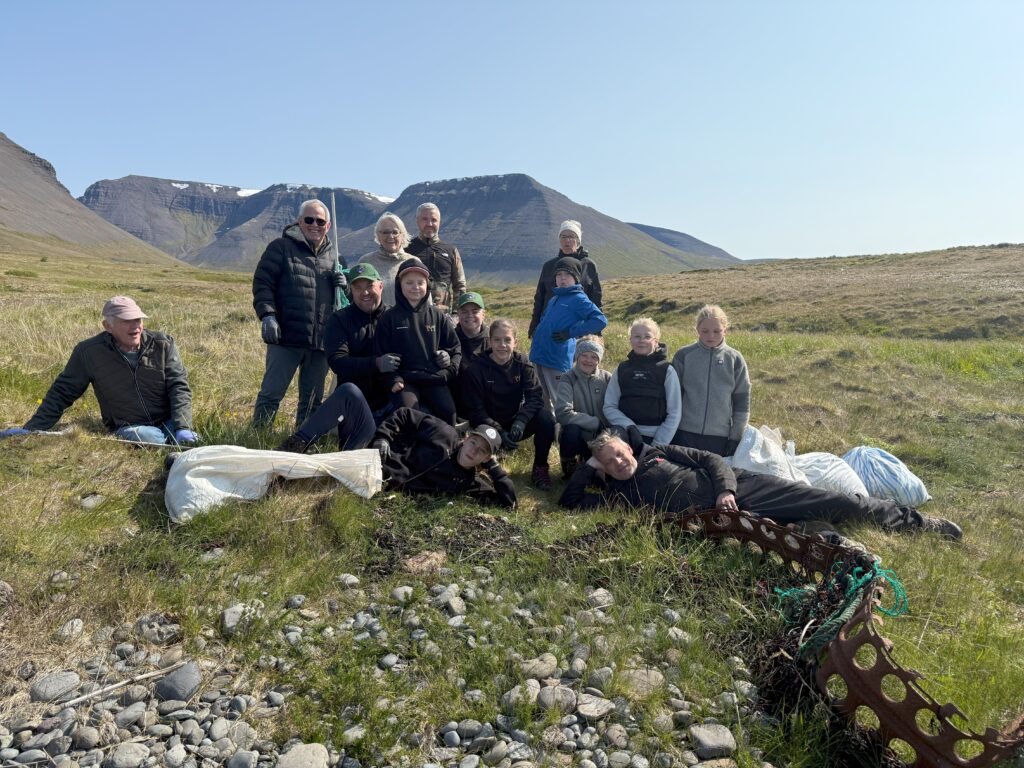
Eiderdown is the only down in the world that is not taken from a bird. It is gathered from the nests by hand, with great care, once the weather is warm enough that the birds no longer need it. This is how it works at Lækur, an eider colony in Dýrafjörður in the Westfjords of Iceland that has been looked after by the same family since 1911.
Spring: the eider come ashore
The common eider is a sea duck. It spends the winter at sea and comes ashore only to nest, from late April into May. The female chooses a spot in the colony, lays four to six eggs and lines the nest with down she plucks from her own breast – a soft, insulating layer that keeps the eggs warm while she sits on them for close to four weeks, barely leaving to eat.
Eider like company and they like safety. Colonies form where the birds have been left in peace for generations, and a well-kept colony grows year by year. That is why Icelandic eider farmers spend the whole nesting season on watch: someone is always nearby, day and night, so that foxes, mink and gulls stay away and the birds can nest undisturbed. At Lækur we also mow back the lupine every July and keep paths open through the colony, so that the birds can see – and be seen.
June and July: the collection
The ducklings hatch in June and follow their mother down to the sea within a day or two. What is left behind is the nest: a shallow cup of grass and seaweed, lined with down and mixed with a little of everything that was around – grass, feathers, eggshell, seaweed.
Our rules for the collection are simple, and the first three are the same: care, care and care. We do not go by the calendar. We wait until the weather is warm enough that the birds and their young do not need the down, and only then do we start walking the colony. If there is any doubt about a nest, the bird gets the benefit of it and we come back another day. Sometimes we take only part of the down and leave a little behind, collecting the rest later; sometimes we take it all. Everything is decided nest by nest, and the point of it all is that the birds are comfortable and the ducklings get safely to the sea.
Every nest is visited on foot. A large colony means thousands of nests spread across hectares of tussocky ground, and there is no machine that can do the walking. A single nest gives roughly 15 to 20 grams of cleaned down, so it takes the down of about sixty nests to make one kilo. At Lækur a good season gives us a few dozen kilos of cleaned down.
One thing cannot wait: the down must go onto the drying racks quickly. Down that comes in damp – and in Icelandic weather much of it does – is spread out over heaters the same day, because down that is dried promptly keeps its quality and yields far more clean down than down that has been left to sit.
Autumn: drying and cleaning
Raw eiderdown is full of grass, seaweed and debris, and much of it comes in damp. At Lækur the work starts the same day: the down goes onto the heaters, is spread out on racks to dry through, and over the following weeks is picked through and rough-cleaned by hand until the coarse material is gone. That takes patience and a surprising amount of electricity, and ours comes from the farm’s own small hydro plant, running since 1947. Each lot then goes for its final cleaning – a heated, rotating drum with mesh that shakes out the last of the fine debris – to the standard the law requires before it can be certified, and is then sewn into duvets in Iceland.
Handling the down: from raw nest material to clean down
Eiderdown is gathered together with everything else that lines the nest: grass, seaweed, twigs, bits of shell and larger feathers. Up to 70 per cent of the weight of what is gathered is not down at all. After the down has been dried and given a first clean by hand, it goes through several steps. First it is heated to about 120 °C, which sterilises it. Then a machine takes out dirt and grass, and a second machine removes most of the feathers. Last of all it is cleaned by hand, because some feathers and bits of dirt always remain, and only hands can make the down truly clean. Finally it is washed in water before it goes into a duvet.
The certificate
Before a single gram can be sold in Iceland or exported, Icelandic law (Act no. 52/2005) requires that the down be fully cleaned and then inspected and weighed by a sworn, government-licensed down assessor. The assessor issues a certificate for each lot. Every Zoffi duvet – and every kilo of loose down that leaves Lækur – comes with that certificate.
Watch: why Icelandic eiderdown is so rare – and so expensive
Business Insider visited Icelandic eider farmers for its So Expensive series and followed the down from the nest to the finished duvet – the watching, the hand collection, the cleaning and the certification. A very good introduction in English, in about ten minutes.
The Icelandic farmers’ newspaper Bændablaðið made this short film about Icelandic eiderdown – the birds, the colonies and the farmers who look after them. It is in Icelandic; click the CC button in the player and choose English under “Auto-translate” if subtitles are not shown automatically.
Why it matters
Eiderdown farming is one of the oldest examples of people and wild animals benefiting from each other. The birds get protection and a safe place to nest; the farmer gets the down they would otherwise leave to the wind. Colonies that are looked after grow; colonies that are abandoned shrink. Every duvet is, in a very direct way, the reason the watch continues.
Zoffi eiderdown duvets are made in Iceland from the down of our own colony at Lækur in Dýrafjörður. See the duvets or write to us with any question – we answer every email ourselves.