
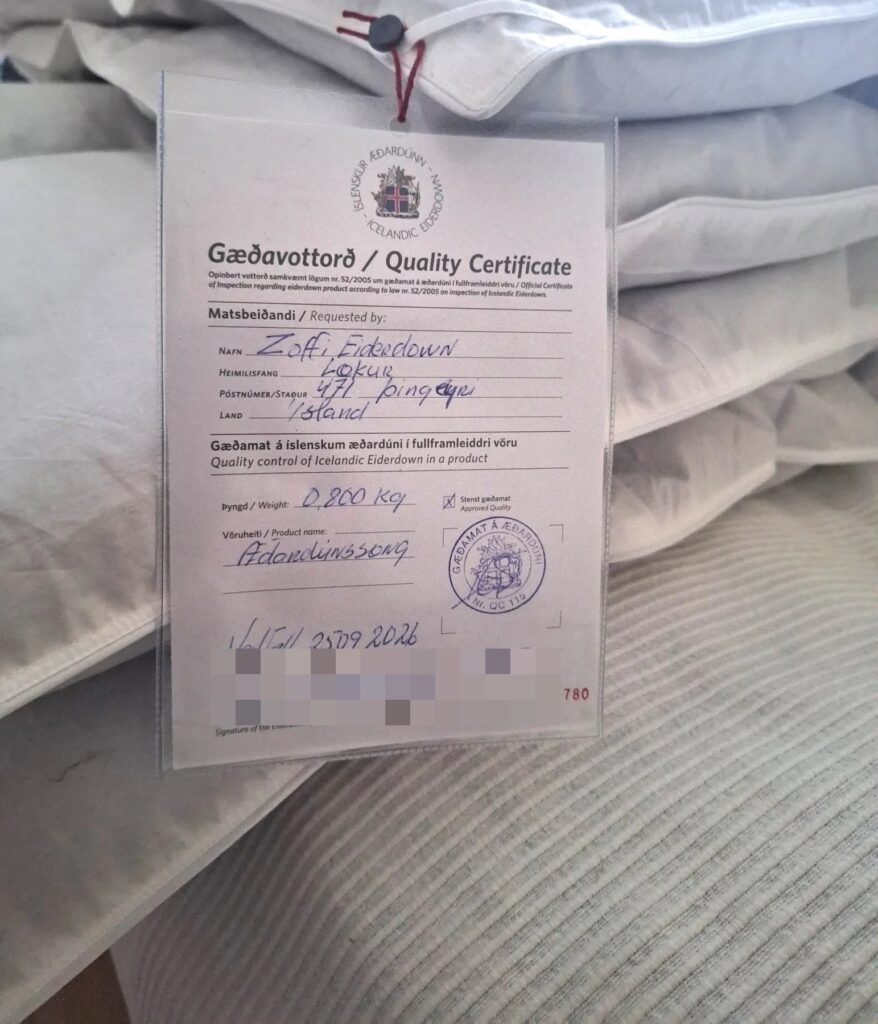
A genuine Icelandic eiderdown duvet is one of the most expensive pieces of bedding you can buy. At Lækur a standard single duvet (140 × 200 cm) delivered outside Iceland costs 389,000 ISK with 400 g of down, 493,000 ISK with 600 g and 614,000 ISK with 800 g – roughly 2,850 to 4,500 euros, or 3,200 to 5,050 US dollars, depending on the exchange rate – with insured courier delivery included and no Icelandic VAT (within Iceland, prices include 24 % VAT and are correspondingly higher). Import VAT and duties in the buyer’s country come on top. Prices vary between makers, so it is well worth comparing offers – and, above all, asking where the down actually comes from and making sure a certificate comes with it. This article explains where the price comes from and how to compare offers sensibly.
Business Insider asked the same question in its So Expensive series and went to Iceland to find out. If you would rather watch than read, start here:
Why eiderdown is so expensive
The short answer is scarcity and labour. The entire world produces only about 3 tonnes of eiderdown a year, most of it in Iceland, because eiderdown cannot be farmed in the usual sense: the birds are wild, they nest where they choose, and the down is gathered from the nests by hand, with great care. It takes the down of about sixty nests to make one kilo of cleaned down, and every nest is visited on foot. Up to 70 per cent of the weight of what is gathered is not down but grass, seaweed, twigs and larger feathers, so every kilo of clean down starts as a much bigger heap. The eider hens only keep coming back – the same hens, year after year, to nest on the same spot – if they feel safe, so protecting the colony is the real work. Add a spring of round-the-clock watching over the colony, weeks of drying and hand-cleaning in the autumn, government inspection and certification, and finally the sewing of the duvet itself, and a single kilo represents a great deal of careful work. For the story behind it in pictures and video, see Why is eiderdown so expensive?
What decides the price of a particular duvet
- Fill weight. The main factor. A summer duvet needs 400 g or so for a single; an all-year duvet 600 g; a warm winter duvet 800 g or more. Double and king sizes need proportionally more.
- Size. A 200 × 220 cm double needs roughly one and a half times the down of a 140 × 200 cm single.
- Cover fabric. A fine, down-proof cotton is standard. Silk covers are available from most makers at a premium of 30–40 %.
- Where the down comes from. Many duvets are sewn by companies that buy down from a number of farms. Buying directly from a farm means you know exactly which colony your down came from – and the farm keeps the whole value of its work.
How to compare offers
Always compare on fill weight and size, not on the headline price. Ask for the weight of down in grams, the exact dimensions and the cover fabric. Make sure the down is certified Icelandic eiderdown – in Iceland that means a certificate from a licensed down assessor under Act no. 52/2005 – and be wary of “eiderdown” duvets that are cheap, vague about origin, or blended with other down. Genuine eiderdown is never cheap, because there is no cheap way to gather it.
What does eiderdown cost per kilo?
Many people who search for a price per kilo are looking for loose eiderdown, not a finished duvet. There is no single market price: it depends on the harvest, on how thoroughly the down has been cleaned and on the certificate that comes with it, which is why producers usually quote per lot rather than publish a price list. We supply certified, cleaned eiderdown to manufacturers on request – see loose eiderdown. A finished duvet, with the down, the cover and the sewing included, is priced at the top of this article.
Is it worth it?
That depends on how you value sleep and time. An eiderdown duvet is extraordinarily light for its warmth, regulates temperature better than any other filling, and lasts for decades with reasonable care – it is not unusual for one to be passed on to the next generation. Spread over thirty or forty years, the cost per night is modest. It is also, quite literally, what keeps the colony protected: every duvet sold pays for another season of the watch. And at Zoffi, 10 % of every product sold from the 2026 harvest is donated to the Lions Club Ásbjörn – our way of giving something back.
Zoffi eiderdown duvets are made in Iceland from the down of our own colony at Lækur in Dýrafjörður. See our Icelandic eiderdown duvets or write to us with any question – we answer every email ourselves.