
Answers to the questions we are asked most often about our Icelandic eiderdown duvets (comforters), made from down gathered at our own eider colony at Lækur in the Westfjords of Iceland. If yours is not here, write to zoffi@zoffi.is and you will get an answer from the farm.
Price, ordering and delivery
How much does a Zoffi eiderdown duvet cost?
For delivery outside Iceland, our standard single duvet (140 × 200 cm) costs 389,000 ISK with 400 g of eiderdown (Summer), 493,000 ISK with 600 g (Classic) and 614,000 ISK with 800 g (Arctic) – roughly €2,850, €3,600 and €4,500 – in a down-proof cotton cover, with insured courier delivery included and no Icelandic VAT; import VAT and duties in your country are payable on arrival. We also make baby, child, long single, double and king duvets (a king, 240 × 220 cm, with 1,500 g of down is 1,040,000 ISK); all sizes are in the table above, and other sizes are possible on request, but take longer. Within Iceland, prices include 24 % VAT – switch the table to “Iceland” to see them. 10 % of every product sold from the 2026 harvest is donated to the Lions Club Ásbjörn.
Do you ship abroad?
Yes, we ship worldwide by tracked courier. Tell us where you are and we will quote shipping together with the duvet; import VAT and any duties in your country are payable on arrival. We keep no stock – every duvet is sewn and washed to order from the current year’s down and its eiderdown certified by a sworn down assessor, which takes up to four weeks, and shipping from Iceland then takes about 3–7 days. See shipping, returns and guarantee.
Do I pay customs duty or VAT when the duvet arrives?
No customs duty within the EU, Norway, Switzerland or the UK – the duvet is made in Iceland and we send the proof of origin with it. You pay your own country’s import VAT to the courier before delivery (19 % in Germany, 21 % in the Netherlands, 20 % in the UK, for example), plus a small courier handling fee. Our written quote states the exact amount for your country, so there are no surprises. Full table by country on the shipping page.
What if the duvet is too warm or too light for me?
We adjust it. Within 60 days of delivery, send it back and our seamstress adds or removes down; the duvet is re-certified at its new weight. You pay the seamstress’s and assessor’s fees and any extra down at cost, plus shipping both ways – nothing for our time. Our three standard duvets (400, 600 or 800 g, 140 × 200 cm) can also be returned within 14 days of delivery for a full refund, if unused, in perfect condition and in their original packaging. Duvets in other sizes or weights are made to your specification and cannot be returned unless faulty. Details under shipping, returns and guarantee.
Do you sell covers or sheets?
No – the duvet comes in its own fine down-proof cotton shell (silk covers are in preparation – ask us), and you put it in a duvet cover of your own, which is what gets washed. Any good natural cover works: cotton, linen or silk. Choose a light one; the whole point of eiderdown is that there is almost no weight on you.
Where does the 10 % go?
Ten per cent of the sale price of everything sold on zoffi.is – calculated on the price excluding VAT, not on profit – is given to a charity we choose for the year. For 2026 it is Lions Club Ásbjörn. We announce each year’s recipient on this page. It is our way of making sure that a duvet from Lækur does a little good beyond the bedroom.
The eiderdown and the farm
Where does the down come from?
All of it comes from our own eider colony at Lækur in Dýrafjörður, in the Westfjords of Iceland, which our family has looked after since 1911. We gather it from the nests by hand, with great care and only once the weather is warm enough for the birds, and dry and process it here on the farm – racks, heaters and the first cleaning by hand, all on electricity from our own hydro plant. Each lot then goes for its final cleaning and certification in Iceland, where the duvets are also sewn.
Is the eiderdown certified?
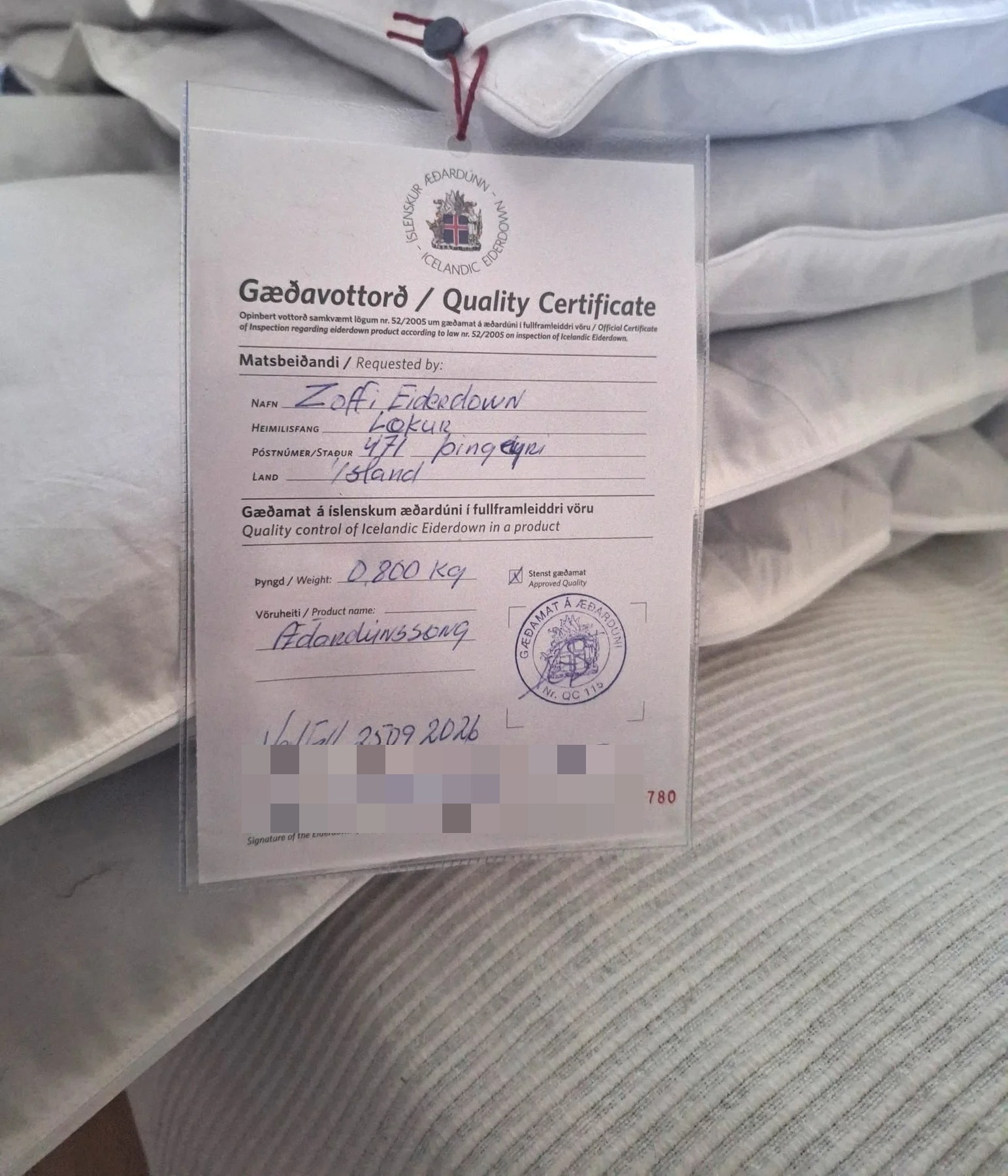
Yes. Under Icelandic Act no. 52/2005 every kilo of eiderdown must be fully cleaned and then inspected and weighed by a sworn, government-licensed down assessor before it can be sold. Every duvet and every bag of loose down from Lækur comes with that certificate. For a duvet, the assessor also weighs and certifies the down, watches it go into the duvet and seals it.
Why is eiderdown so expensive?
Scarcity and hand labour. The whole world produces only a few tonnes of eiderdown a year, most of it in Iceland, and none of it can be farmed: the birds are wild, and the down is gathered from the empty nests by hand, one nest at a time. It takes the down of about sixty nests to fill one kilo. Add a spring of round-the-clock watching over the colony, weeks of drying and hand-cleaning, government grading, and the sewing itself, and the price follows. Read more: How much does an eiderdown duvet cost – and why?
Why eiderdown rather than goose down?
More warmth for less weight, and it lasts. Eiderdown filaments carry tiny hooks that cling together, so the filling holds its shape without the heavy stitching goose down needs, and it springs back after every compression. A 600 g eiderdown duvet is a comfortable all-year duvet where goose down would need 800–1,200 g. It breathes exceptionally well – never stuffy – and with ordinary care it is used for decades, often passed on in the family. Read more: Eiderdown vs goose down.
Are the birds harmed?
No. Eiderdown is the only down in the world that is not taken from a bird. The female lines her nest with down from her own breast; we gather it from the nest by hand after the ducklings have followed her to the sea. The birds come back year after year because the colony is kept safe – someone is on watch day and night through the nesting season against foxes, mink and gulls. A colony that is cared for grows; ours has been looked after by the same family since 1911. Read more: How is eiderdown harvested?
Can I buy loose eiderdown instead of a duvet?
Certified, fully cleaned eiderdown is available directly from the farm on request, for those who prefer to have their own duvet or pillow made. Email zoffi@zoffi.is and tell us what you have in mind.
Choosing and caring for your duvet
Which weight should I choose?
Summer (400 g in a standard single, about 145 g of down per m²) is a light duvet for warm bedrooms; Classic (600 g, about 215 g/m²) is a balanced all-year weight for most homes and our most popular weight outside Iceland; Arctic (800 g, about 285 g/m²) is the most popular in Iceland – for cold rooms, cool Nordic bedrooms and people who feel the cold. The down weight grows with the size of the duvet, so the warmth stays the same in every size. If you are unsure, choose Classic (600 g) – it suits most homes and most sleepers – or tell us how you sleep and we will suggest a weight before you order. Every duvet is made to order, so it is worth getting the weight right from the start.
Duvet, comforter, quilt – what’s the difference?
The same thing, named differently. In Britain and most of Europe it is a duvet, in North America a comforter, and an older word for it is eiderdown itself. All our duvets are sized in centimetres. We sew in the sizes in the table above; for other sizes, tell us the dimensions you sleep under – or the bed size and country – and we will tell you whether we can make it to fit, and how long it takes.
How do I care for an eiderdown duvet – and how long does it last?
Less than you would think. An eiderdown duvet lives in a cover, and the cover is what gets washed – the duvet itself almost never does. Eider clusters carry very little natural oil, which is one reason the filling stays fresh for years without picking up smells, and the down breathes so well that the duvet dries out on its own if you fold it back for a while in the morning. Beyond that, hang it in the wind for an hour or two now and then – Icelandic winter air is perfect – and keep it away from direct heat. We would not send a duvet for a full clean more than once a decade, and many never need it. Duvets looked after like this outlive their owners; ours are meant to. Our care guide.