
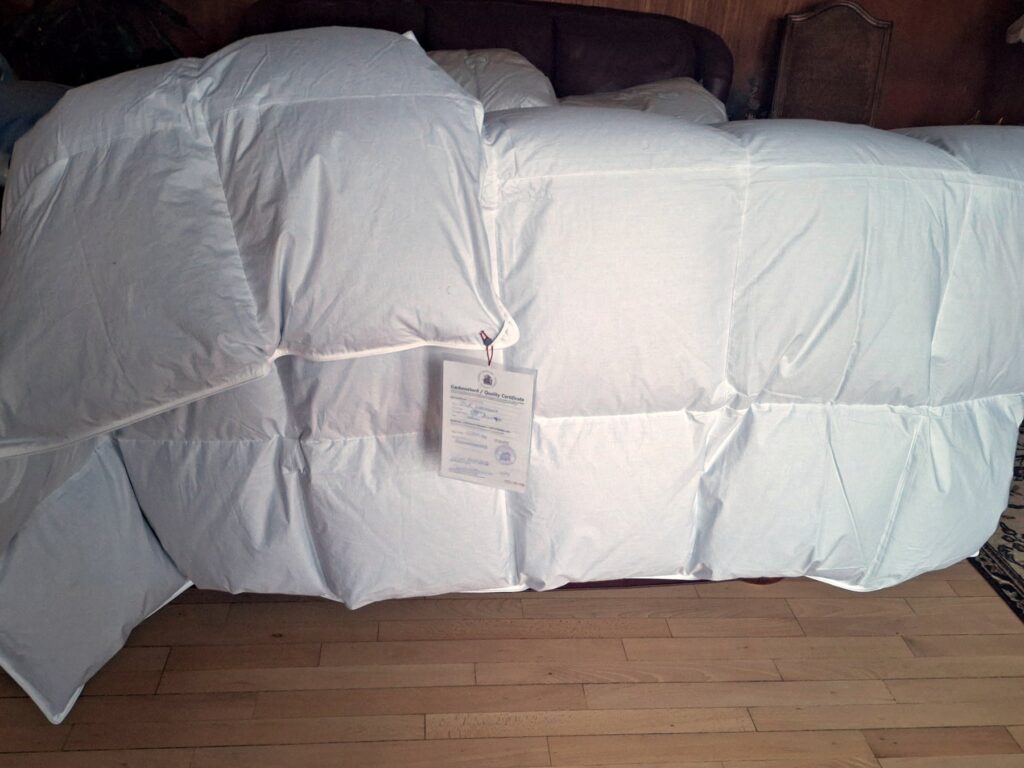
The short version: an eiderdown duvet asks less of you than any other bedding. It lives in a cover, and the cover is what gets washed – the duvet itself almost never does. Eider clusters carry very little natural oil, which is one reason the filling stays fresh for years without picking up smells, and the down breathes so well that the duvet dries out on its own if you fold it back for a while in the morning. Hang it in the wind for an hour or two now and then, keep it away from direct heat, and you are done. We would not send a duvet for a full clean more than once a decade, and many never need it. Duvets looked after like this outlive their owners; ours are meant to.
Here is how we look after our own, in a little more detail.
Every day
Shake the duvet lightly in the morning and leave it folded back for a while before making the bed, so the moisture from the night can escape. Eiderdown breathes well, but it works best when it is allowed to dry out between nights.
Use a cover, always
Keep the duvet in a duvet cover at all times and wash the cover as you would any bedding. The cover takes the wear and the washing; the duvet itself should rarely, if ever, need to be washed.
Air it, often
Airing is the single most useful thing you can do. Hang the duvet outside in the wind, in the shade rather than strong sun, for an hour or two whenever the weather allows – a few times a year is plenty. Cold winter air does it the most good. Airing freshens the down, lets it fully loft, and keeps the filling in good condition for years.
Washing
Do not wash an eiderdown duvet at home. Wet down is heavy and fragile, and household machines and dryers can break the clusters or leave the filling damp in the middle. If the duvet is stained, spot-clean the cover fabric gently with a damp cloth and let it dry thoroughly. If it genuinely needs a full clean – every five to ten years is plenty – take it to a specialist cleaner with experience of eiderdown, or ask us for advice first.
Storage
Store the duvet dry, in a breathable cotton bag, in a cool place. Never store it in plastic, never compress it for long periods, and never put it away damp.
Things to avoid
- Beating the duvet hard or wringing it.
- Direct heat: radiators, tumble dryers, strong sun for hours.
- Pets and children jumping on it (a little is fine; a lot breaks the clusters).
- Letting the duvet get damp and stay damp.
When to have it looked at
If the filling has shifted or thinned in places after many years, an eiderdown duvet can usually be opened, the down cleaned and topped up, and the duvet re-sewn. That is one of the quiet advantages of eiderdown over other fillings: it is worth repairing. Write to us at zoffi@zoffi.is and we will tell you what is possible.
Zoffi eiderdown duvets are made in Iceland from the down of our own colony at Lækur in Dýrafjörður. See the duvets or write to us with any question – we answer every email ourselves.